

Please enter an introduction for your blog post here.
Why Girls often stop putting their hand up in class - and how girls' schools help
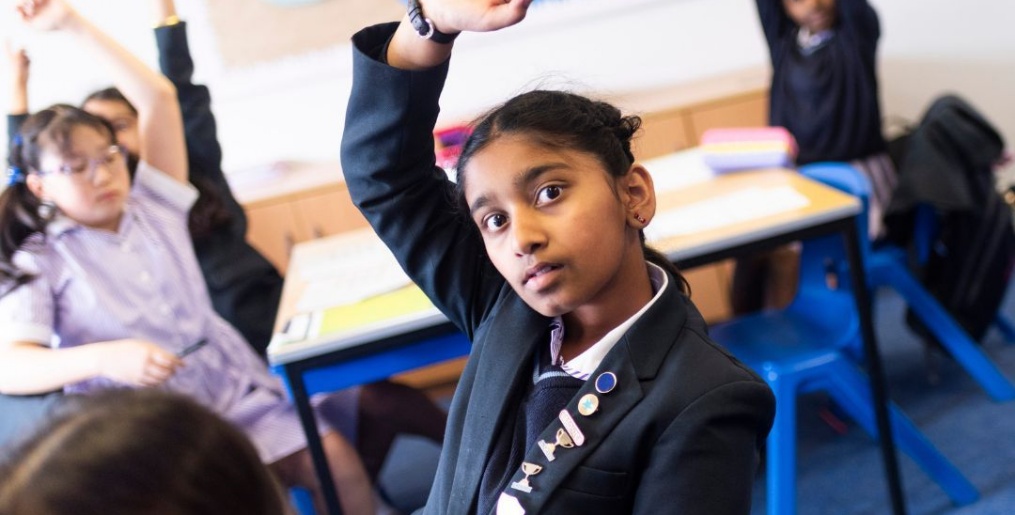
A teacher asks a question. A girl knows the answer, but still hesitates before raising her hand.
It is easy to assume that hesitation means she has not revised, is not concentrating or simply does not know the answer. Often, though, that is not the case at all.
Many girls are weighing up a different set of thoughts entirely:
What if I get it wrong?
What if everyone looks at me?
What if I sound stupid?
What if I seem too keen?
By the time girls reach adolescence, many become highly aware of how they appear to others. Research has shown that girls’ confidence can dip during the teenage years, particularly in classroom settings where they fear judgement or embarrassment. Even academically able students can begin to hold back.
That is why confidence in school matters so much. It is not simply about having knowledge. It is about feeling able to use your voice, contribute ideas and take part without fear of getting something wrong.
At Leicester High School for Girls, we see confidence as something that develops over time. It is not a personality trait that some girls naturally possess and others do not. Like resilience or communication skills, it grows through practice, encouragement and experience.
Why does a girls’ school environment make a difference?
People often talk about girls’ schools in terms of academic results, and understandably so. But one of the most noticeable differences is often what happens inside the classroom itself.
In a girls’ school, girls are not competing to be heard as the exception in the room. They are surrounded by other girls asking questions, leading discussions, solving problems, performing on stage, competing in sport and taking on positions of responsibility.
Over time, that changes what feels normal.
Girls become more willing to contribute their thoughts, volunteer ideas and try subjects they may once have viewed as “not for them.” Leadership becomes something they see regularly rather than something unusual.
Importantly, they also become more comfortable with making mistakes. In healthy learning environments, getting something wrong is recognised as part of the process rather than something to avoid at all costs.
That does not mean every girl suddenly becomes loud or extroverted. Confidence looks different in different people. Some girls grow into articulate public speakers, while others develop a quieter self-assurance. Both matter.
Confidence is built in small moments
Confidence rarely appears overnight. More often, it develops quietly through everyday experiences at school.
It grows when a girl answers a difficult question, gives a presentation, joins a new club, speaks in assembly, performs in a concert or keeps going after something has not gone to plan.
A good school does not remove challenge. Instead, it creates an environment where pupils feel secure enough to face challenge without fearing embarrassment.
That idea sits at the heart of life at Leicester High School for Girls. We want every girl to feel known, valued and inspired to be her best. In practice, that means noticing the quieter voices as well as the naturally confident ones, and giving girls repeated opportunities to speak, lead, question and grow.
Why this still matters
The world our students are entering will ask more of them than simply achieving good grades. They will need to communicate clearly, think independently, collaborate with others and have the confidence to contribute their ideas.
Schools cannot remove self-doubt entirely, and nor should they try to create perfect students. But education can help young people become more willing to speak up, take part and trust their own voice.
Sometimes, that starts with something as small as putting a hand up in class — even when they are not completely certain of the answer.